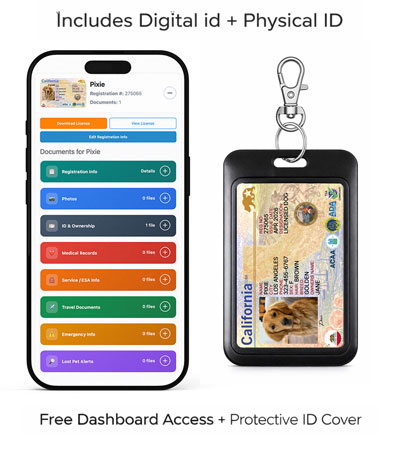
San Francisco,California Dog Registration Information
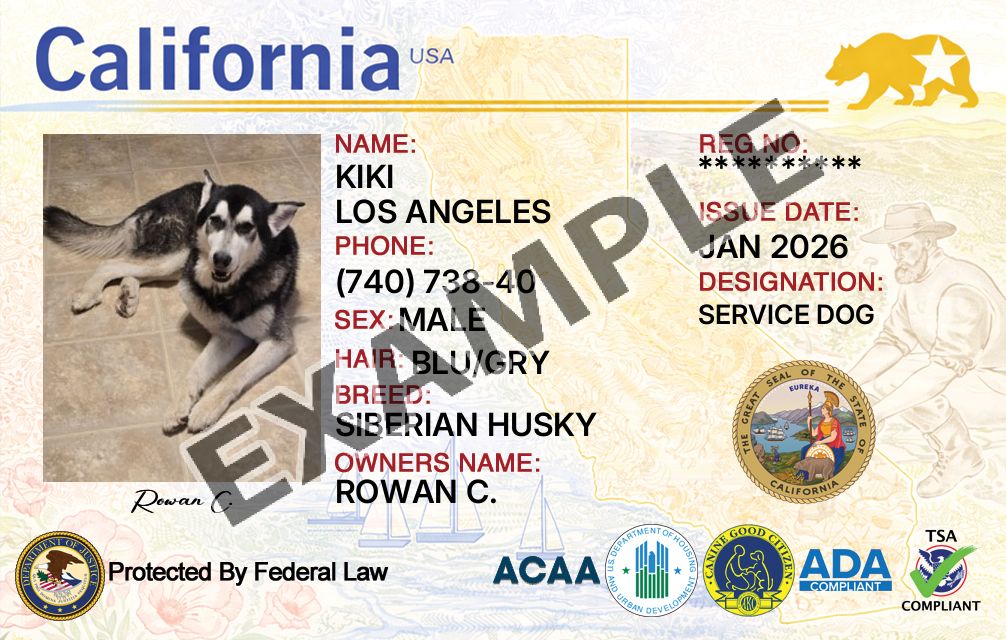
State Licensed, Service Dogs and Emotional Support Dogs in California
If you’re searching where do I register my dog in San Francisco, California for my service dog or emotional support dog, it helps to separate three things that people often mix together: (1) the local dog license in San Francisco, California, (2) the dog’s rabies vaccination status (which is usually required to license), and (3) the legal status of a service dog or emotional support animal. In San Francisco, licensing is handled locally, and the most common “registration” residents mean is a city dog license tied to current rabies vaccination.
- Licensing is local: Most dog licensing is handled at the city/county level, not by a national registry.
- Service dog status is not the same as a license: A service animal’s legal status generally comes from training and applicable disability rights laws, not from a city “registration.”
- Emotional support animals (ESAs) are different: ESAs are typically addressed in housing contexts; they are not “registered” like a service dog, and they do not replace local licensing rules.
Where to Register or License Your Dog in San Francisco, California
When people ask where to register a dog in San Francisco, California, they’re usually looking for an official office that issues or supports the city dog license and enforces animal control and rabies-related rules. Below are example official offices and departments within San Francisco that residents commonly use for licensing, animal control support, and service/support animal accessibility questions. If a detail (like an email or hours) is not publicly provided in the referenced official source, it is intentionally omitted.
Official offices (examples within San Francisco)
| Office | Address | Phone | Office Hours | |
|---|---|---|---|---|
|
San Francisco Animal Care & Control (SFACC)
General information; licensing support; animal control
|
1419 Bryant Street (at Alameda) San Francisco, CA 94103 |
(415) 554-6364 | ACC@sfgov.org |
Sun 12:00 pm–5:00 pm Mon Closed Tue 12:00 pm–5:00 pm Wed 12:00 pm–5:00 pm Thu 12:00 pm–5:00 pm Fri 12:00 pm–5:00 pm Sat 12:00 pm–5:00 pm |
|
San Francisco Animal Care & Control (SFACC)
Emergency dispatch / animal control officers
|
1419 Bryant Street (at Alameda) San Francisco, CA 94103 |
(415) 554-9400 | Not listed | Animal Control Officers on duty 6:00 am–12:00 am |
|
Treasurer & Tax Collector (City Hall)
In-person processing location listed on the official application form
|
City Hall - Room 140 1 Dr. Carlton B. Goodlett Place San Francisco, CA 94102 |
Not listed | Not listed | Mon–Fri 8:30 am–5:00 pm |
|
Mayor’s Office on Disability (MOD)
City accessibility questions involving service/support animals
|
Not listed | (415) 554-6789 | MOD@sfgov.org | Not listed |
Overview of Dog Licensing in San Francisco, California
What “registering your dog” usually means in San Francisco
In San Francisco, “registering” most often means obtaining a dog license in San Francisco, California—a local license tag tied to your dog and your local address. Licensing supports animal control services and helps reunite lost dogs with their families. It can also be important documentation if there’s a complaint, bite report, or other animal control issue where proof of ownership and rabies compliance matters.
Licensing is local (city/county), not a national registry
There is no single nationwide “service dog registry” or “ESA registry” that replaces local licensing. San Francisco licensing is handled locally, and you’ll generally be asked for documentation such as a government-issued photo ID and proof of current rabies vaccination when applying in person. If your dog’s rabies vaccination expires, your license typically cannot extend past that rabies expiration date.
Rabies vaccination requirements and why they matter
Rabies prevention is one of the core reasons cities require licensing. In San Francisco, licensing is tied to rabies compliance: if your dog’s rabies vaccination expires, the dog’s license is not meant to remain valid beyond that date. Keeping rabies vaccination current is also a key public health step—especially relevant if a dog bites someone or is involved in an incident that triggers animal control and public health follow-up.
How Dog Licensing Works Locally in San Francisco, California
Step-by-step: typical licensing process
- Confirm your dog needs a license. A license is required for dogs over a certain age and residency period in San Francisco (commonly described as dogs older than 4 months that have lived in San Francisco for 30 days or more).
- Get (or confirm) a current rabies vaccination. Ask your veterinarian for a rabies certificate or official documentation showing the vaccination and expiration date.
- Gather your documentation. Many residents bring a government-issued photo ID and a current rabies certificate when applying in person.
- Apply through an official channel. San Francisco commonly provides in-person options at SFACC and at the Treasurer & Tax Collector location listed on the official application form. (Some residents also license by mail, depending on the city’s current procedures.)
- Pay the licensing fee and keep the tag information. Your tag number is important for renewals, replacements, and proving the license is associated with your dog.
- Renew on time and update rabies documentation as needed. If rabies documentation changes (new shot, new expiration), update it so your dog’s license remains valid.
Where your “service dog” or “ESA” fits into licensing
Whether your dog is a pet, a service dog, or an emotional support dog, the local dog license requirement typically still applies if your dog lives in San Francisco. In other words: service dog status does not automatically replace the city licensing requirement. Licensing and rabies compliance are about public health and animal control identification; service/ESA rules are about disability accommodations in specific settings.
Common reasons people get stuck (and how to avoid delays)
- Rabies expiration date mismatch: If your rabies shot expires soon, you may only be able to purchase a license term that matches that expiration window.
- Missing documentation: Bring clear rabies proof and identification before visiting an office.
- Assuming an online “registry” is official: Many third-party sites market “registration,” but they are not the city’s licensing authority. Use official city offices for licensing.
Service Dog Laws in San Francisco, California
What counts as a service animal
A service animal is generally a dog (and in some cases a miniature horse) that is individually trained to do work or perform tasks for a person with a disability. The key elements are: disability-related need and task-trained assistance. This differs from comfort-only support where the animal’s presence is beneficial but the animal is not trained to perform specific tasks.
Do you have to “register” a service dog in San Francisco?
There is no general legal requirement to carry a special service tag to prove service dog status. However, some people choose to obtain local assistance identification or tags that can make day-to-day interactions smoother. Importantly, that is separate from the city dog license, and it does not replace the need to keep rabies vaccinations current and to comply with local licensing rules.
Handler responsibilities in public
Service animals must be under the handler’s control and should not be disruptive or pose a health or safety threat. In practice, this means good behavior, control, and up-to-date vaccinations and rabies identification. Even when service animals have expanded access rights, local public health rules (like rabies compliance) still apply.
Emotional Support Animal Rules in San Francisco, California
What an emotional support animal (ESA) is—and isn’t
An emotional support animal helps a person by providing comfort that reduces symptoms of a psychological disability. ESAs are not necessarily trained to perform specific tasks. Because of this, ESAs are treated differently than service animals in many settings—especially private businesses and places that prepare or sell food.
Housing is the most common ESA context
ESAs are frequently addressed through housing-related accommodation rules. In a housing setting, you may be asked to provide documentation from a medical professional verifying a disability-related need. Landlords may also request proof of vaccinations and require an agreement that you take responsibility for the animal’s behavior.
Licensing still applies
Even if your dog is an emotional support animal, you generally still need the local dog license in San Francisco, California if your dog resides in the city and meets the age/residency thresholds. So if your main question is where do I register my dog in San Francisco, California for my service dog or emotional support dog, the practical answer is: you get your local dog license through official San Francisco offices, and you address service/ESA accommodation needs separately depending on where you need access (housing, workplace, public facilities, etc.).
Frequently Asked Questions
Register A Dog In Other San Francisco Counties
Select your county from the dropdown below to get started with your dog’s ID card. Requirements and license designs may vary by county, so choose your location to see the correct options and complete your pup’s registration.
- Alameda County Dog Registration
- Alpine County Dog Registration
- Amador County Dog Registration
- Butte County Dog Registration
- Calaveras County Dog Registration
- Colusa County Dog Registration
- Contra Costa County Dog Registration
- Del Norte County Dog Registration
- El Dorado County Dog Registration
- Glenn County Dog Registration
- Humboldt County Dog Registration
- Imperial County Dog Registration
- Inyo County Dog Registration
- Kern County Dog Registration
- Kings County Dog Registration
- Lake County Dog Registration
- Lassen County Dog Registration
- Madera County Dog Registration
- Marin County Dog Registration
- Mariposa County Dog Registration
- Mendocino County Dog Registration
- Merced County Dog Registration
- Modoc County Dog Registration
- Mono County Dog Registration
- Monterey County Dog Registration
- Napa County Dog Registration
- Nevada County Dog Registration
- Orange County Dog Registration
- Placer County Dog Registration
- Plumas County Dog Registration
- San Benito County Dog Registration
- San Bernardino County Dog Registration
- San Joaquin County Dog Registration
- San Luis Obispo County Dog Registration
- San Mateo County Dog Registration
- Santa Barbara County Dog Registration
- Santa Clara County Dog Registration
- Santa Cruz County Dog Registration
- Shasta County Dog Registration
- Sierra County Dog Registration
- Siskiyou County Dog Registration
- Solano County Dog Registration
- Sonoma County Dog Registration
- Stanislaus County Dog Registration
- Sutter County Dog Registration
- Tehama County Dog Registration
- Trinity County Dog Registration
- Tulare County Dog Registration
- Tuolumne County Dog Registration
- Ventura County Dog Registration
- Yolo County Dog Registration
- Yuba County Dog Registration